

Intermédiaire
Vous entendez parler d’Artrade et de sa cryptomonnaie (ATR) ? Bien qu’il s’agisse d’un projet à petite capitalisation, son ambition est de proposer une plateforme combinant art, blockchain et certification numérique. Dans cet article, nous allons explorer les fondements d’Artrade, sa vision, ses fonctionnalités-clés, et les atouts qu’elle entend apporter au marché de l’art. Nous garderons toutefois à l’esprit que le projet n’a pas (pour l’instant) la place majeure de certains grands acteurs établis dans le Web3.
Le marché de l’art est souvent perçu comme réservé à une élite, et un nombre croissant d’initiatives cherchent à le rendre plus accessible et transparent. La cryptomonnaie ATR se présente comme le cœur de l’écosystème Artrade, soutenant un éventail de services : la fractionnalisation d’œuvres, la DAO (gouvernance décentralisée) ou encore l’utilisation de NFC chips pour authentifier des pièces physiques. Cependant, ce projet reste encore en cours de développement, avec une capitalisation de marché modeste et une adoption qui demeure à consolider.
Dans les paragraphes qui suivent, nous plongerons dans les aspects majeurs du projet Artrade en explicitant ses éléments de tokenomics, son modèle économique et sa feuille de route. Bien entendu, tout nouvel entrant dans le secteur crypto doit garder un œil critique sur la fiabilité et la viabilité d’un projet encore jeune.
Table des matières
Contexte et raison d’être : pourquoi Artrade et sa crypto ATR ?
L’enjeu de la transparence dans l’art
Le marché de l’art est souvent perçu comme opaque et complexe, notamment en raison des défis liés à l’authentification et à la provenance des œuvres. Certaines estimations – discutées dans le milieu – suggèrent qu’une part importante des pièces mises sur le marché pourrait être mal attribuée ou contrefaite. Le Fine Art Expert Institute (FAEI), par exemple, a évoqué jusqu’à 50 % de taux de contrefaçon ou d’attribution erronée dans les années 2010, bien que ce chiffre soit régulièrement débattu et ne fasse pas l’unanimité.
Dans ce contexte, la blockchain émerge comme une piste pour créer un système d’authentification et de traçabilité plus robuste, permettant de relier chaque transaction à un registre inviolable. L’idée est de réduire la dépendance à de multiples intermédiaires, tout en donnant aux collectionneurs et aux artistes une visibilité claire sur l’historique de l’œuvre.
La décentralisation comme piste
La décentralisation propose en théorie plusieurs avantages :
- Authentification renforcée : Chaque transaction est inscrite dans un registre public (blockchain), ce qui limite les risques de falsification des certificats.
- Réduction des coûts : En réduisant le rôle des intermédiaires, la blockchain pourrait simplifier et potentiellement alléger certains frais de transaction.
Cependant, l’adoption de ces systèmes demande du temps et suscite des défis, qu’ils soient techniques (développement de plateformes sécurisées, intégration de puces NFC, etc.) ou liés à la confiance. Artrade, jeune projet souhaitant appliquer ces principes dans le marché de l’art, doit encore démontrer que sa solution est à la fois viable à grande échelle et suffisamment attrayante pour convaincre artistes, galeristes et collectionneurs d’y participer.
Aperçu du projet crypto Artrade
Ambitions et proposition de valeur d’Artrade
Artrade cherche à fusionner l’art traditionnel et la blockchain, dans le but d’offrir plus de transparence, de sécurité, et de liquidité à un univers souvent perçu comme réservé à des initiés. L’un de ses principes de base est d’utiliser la tokenisation :
- Création et vente de NFTs : Les artistes peuvent associer leurs œuvres physiques à un jeton numérique.
- Fractionnalisation : Proposer à plusieurs acquéreurs de posséder des parts (ou “Fragments”) de la même œuvre.
- Authentification : L’emploi de puces NFC et de la blockchain pour renforcer la traçabilité.
Cependant, il est essentiel de noter que le potentiel d’Artrade reste à confirmer. Le marché de l’art en crypto est hautement concurrentiel, et la confiance des utilisateurs ne se construit qu’au fil du temps.
Une jeune entreprise innovante française
Artrade est reconnu comme une JEI (jeune entreprise innovante) en France. Son financement initial provient d’une ICO (Initial Coin Offering) de jetons ATR en 2021. À ce jour, le projet se développe à l’international, mais n’a pas encore acquis une envergure institutionnelle comparable à d’autres plateformes NFT établies. Sa présence se fait toutefois remarquer lors de divers événements (Paris Blockchain Week, Non Fungible Conference, etc.), ce qui atteste d’une volonté de créer un réseau et de stimuler l’adoption.
Plus di’nformations sur les récompenses ici
Principales fonctionnalités d’Artrade
Fragments : la fractionnalisation des œuvres par le projet crypto Artrade
Artrade a dévoilé la fonctionnalité Fragments, conçue pour rendre plus accessible l’investissement dans l’art en fractionnalisant des œuvres de grands maîtres (Monet, Picasso, Warhol, etc.). Selon les informations publiées sur le site officiel d’Artrade et dans leurs communiqués récents, le premier lancement concerne un dessin de Pablo Picasso, estimé à 200 000 USD, dont la prévente a débuté lors de la Non Fungible Conference (NFC) à Lisbonne.
- Principe : L’œuvre physique est tokenisée sur la blockchain Solana et scindée en plusieurs parts (ou “fragments”). Chaque investisseur peut ainsi acheter une fraction de ce chef-d’œuvre, au lieu d’acquérir la pièce complète.
- Objectif : Offrir une liquidité accrue au marché de l’art et ouvrir l’accès à des œuvres habituellement hors de portée pour le grand public.
- État actuel :
- La première vente Fragments porte sur ce Picasso. Après la prévente, chaque fraction devrait être échangeable sur un DEX compatible Solana, comme n’importe quel autre token.
- le concept est encore en phase de démonstration et de test auprès des premiers utilisateurs.
- Points de vigilance :
- Il reste indispensable de s’assurer de la conservation de l’œuvre (entrepôt spécialisé, assurance, etc.) et de comprendre la structure légale qui encadre la détention partagée.
- Le modèle doit encore être éprouvé à plus grande échelle, notamment pour la revente ou la liquidité sur les marchés secondaires.
En résumé, Fragments ouvre des perspectives intéressantes pour démocratiser l’achat d’art via la blockchain, même si le nombre réel d’investisseurs et la stabilité de ce nouveau marché demeurent à observer au fur et à mesure de la mise en place de ces premiers cas concrets.
REAL Protocol : certifier l’authenticité
Artrade a mis en place le REAL Protocol, qui vise à renforcer la fiabilité et la traçabilité des œuvres d’art physiques. Concrètement, le processus se déploie en plusieurs étapes :
Création du NFT
Un NFT (Non-Fungible Token) est tout d’abord émis sur la blockchain pour représenter l’œuvre. Ce jeton sert d’empreinte numérique unique, associée à la version physique de la pièce.Apposition de la puce NFC
- Une puce NFC (Near Field Communication) ou un dispositif similaire (par exemple, un tag RFID) est ensuite fixé directement sur l’œuvre, souvent au dos de la toile ou dans un cadre protecteur pour les tableaux.
- Cette puce embarque un identifiant unique et infalsifiable, lié au NFT. L’idée est que quiconque souhaite vérifier l’authenticité puisse “scanner” la puce avec un smartphone ou un lecteur NFC compatible et accéder instantanément aux informations inscrites sur la blockchain (historique de propriété, date de création, etc.).
Escrow Smart Contract
- Au moment de la transaction (achat/vente), un contrat intelligent (smart contract) de type escrow entre en jeu.
- Rôle de l’escrow : Bloquer aussi bien les fonds de l’acheteur que le transfert du NFT sur la blockchain le temps que l’œuvre soit livrée.
- Déroulement :
- L’acheteur envoie le paiement dans l’escrow (un smart contract automatisé).
- Le NFT demeure également en attente au sein de ce smart contract.
- L’œuvre est expédiée au nouvel acquéreur.
- Lors de la réception, l’acheteur peut scanner la puce NFC pour confirmer que l’œuvre correspond bien au NFT et qu’elle est authentique.
- Une fois cette vérification effectuée et validée, les fonds sont débloqués pour le vendeur et le NFT est définitivement transféré dans le portefeuille de l’acheteur.
En pratique, ce système pourrait considérablement réduire les incertitudes liées à la contrefaçon ou à la mauvaise attribution des œuvres, grâce à la combinaison de la blockchain et de la puce NFC scellée sur l’objet physique. Toutefois, l’efficacité du REAL Protocol dépendra de l’adhésion des artistes, des galeries et des collectionneurs, afin que ce mode de certification devienne un standard. À ce jour, il est encore difficile de mesurer combien de personnes utilisent effectivement ce protocole, le marché étant en phase d’adoption progressive.
DAO d’Artrade : une gouvernance communautaire en construction
Artrade exprime la volonté de passer progressivement d’une gestion centralisée à une DAO (Decentralized Autonomous Organization). Concrètement, les détenteurs du token ATR pourraient soumettre ou voter des propositions liées à la stratégie, aux initiatives de communication ou au financement de projets artistiques.
51 % de l’offre totale allouée à la DAO
- Cela signifie que plus de la moitié (51 %) de tous les tokens ATR émis sont censés être destinés à cette gouvernance.
- Dans la pratique, ces tokens pourraient être répartis entre des caisses de la DAO, des plans de staking ou des fonds de soutien à des artistes.
- L’idée est que la communauté puisse détenir un pouvoir décisionnaire majoritaire, assurant à terme que les choix importants (par exemple, quelles expositions financer, quels partenariats signer) soient validés par une majorité de la communauté plutôt que par une équipe restreinte.
Enjeux de légitimité
- Comme pour toute DAO, il est nécessaire qu’un nombre suffisant de détenteurs de tokens participent activement pour que les votes soient représentatifs.
- Un faible taux de participation peut remettre en question la légitimité des décisions, ce qui est un défi courant dans l’univers des organisations décentralisées.
Partenariats et autres services avec Artrade
Artrade met en avant plusieurs collaborations visant à enrichir son écosystème. Selon les informations disponibles à ce jour, certains partenariats sont déjà effectifs, tandis que d’autres relèvent encore de projets futurs.
- Moonpay (partenariat effectif)
Objectif : Permettre aux utilisateurs d’acheter plus facilement des tokens ATR avec leur carte de crédit, sans forcément passer par une bourse d’échange.
Intérêt : Simplifier l’accès à la plateforme pour les non-initiés aux cryptomonnaies, et réduire la barrière à l’entrée (ouverture de wallets, gestion d’USDC, etc.).
- Subsidiary services et co-création
- Artrade projette de proposer des abonnements payants pour les galeries ou experts de l’art, offrant des fonctionnalités avancées de gestion, d’analyse de marché et de mise en avant.
- Un système de co-création est également évoqué, permettant aux galeristes et artistes de formaliser leur partenariat via la blockchain, avec un partage automatisé des revenus lors des ventes
- Initiatives Web3 : staking
- La plateforme prévoit des plans de staking où les détenteurs d’ATR bloquent leurs tokens en échange d’un APY (jusqu’à 30 % annoncé).
- Les revenus liés aux frais de transaction pourraient soutenir le programme de staking via un mécanisme de rachat (buyback) et de redistribution.
En résumé, Artrade entend développer un écosystème global, associant la certification d’œuvres (REAL Protocol), la fractionnalisation (Fragments), et un modèle de gouvernance décentralisée (DAO). Les partenariats effectifs, comme celui avec Moonpay, visent à fluidifier l’accès à la plateforme, tandis que d’autres collaborations annoncées restent à concrétiser.
Zoom sur la Tokenomics du projet crypto Artrade et son token ATR
Caractéristiques de base
- Nom : Artrade Token (ATR).
- Total supply : 1,8 milliard de tokens.
- Date de lancement : Avril 2022.
- Blockchain d’origine : Binance Smart Chain (BSC).
- Migration vers Solana depuis Q1 2024.
- Adresses smart contract :
- BSC : 0x7559C49c3Aec50E763A486bB232fA8d0d76078e4
- Solana : ATRLuHph8dxnPny4WSNW7fxkhbeivBrtWbY6BfB4xpLj
Rôles du token ATR
- Gouvernance : Participer aux votes de la DAO, définir des budgets de promotion, soutenir des artistes.
- Staking : Verrouiller ses ATR pour recevoir un APY (allant jusqu’à 30 %, selon les annonces). Les récompenses initiales proviendraient d’une réserve spécifique, puis d’un buyback quotidien sur le marché via les frais de plateforme.
- Programme de burn : Pour chaque token émis en récompense de staking, un token est brûlé afin de maintenir la raréfaction de l’offre.
- Utilisations sur la plateforme : Achat d’œuvres, cashback de 2,5 % pour acheteur et vendeur, accès à des badges et fonctionnalités premium.
Émissions et vesting de l’ATR
Un calendrier (vesting) a été communiqué pour la libération progressive des tokens :
- Nov. 2023 : 84,59 % en circulation.
- Déc. 2023 : 88,44 %.
- Janv. 2024 : 92,29 %.
- Févr. 2024 : 96,15 %.
- Mars 2024 : 100 %.
La logique proposée est de lisser l’impact sur le marché. Pour les early adopters, la question sera de vérifier comment l’équipe gère ce processus et la migration annoncée vers Solana.
Staking et burn du token ATR
Une supply fixe, sans inflation
L’ensemble des 1,8 milliard d’ATR a déjà été minté (créé) dès le lancement du projet. Contrairement à d’autres cryptomonnaies qui augmentent leur supply au fil du temps, Artrade ne prévoit aucun mécanisme de mint additionnel.
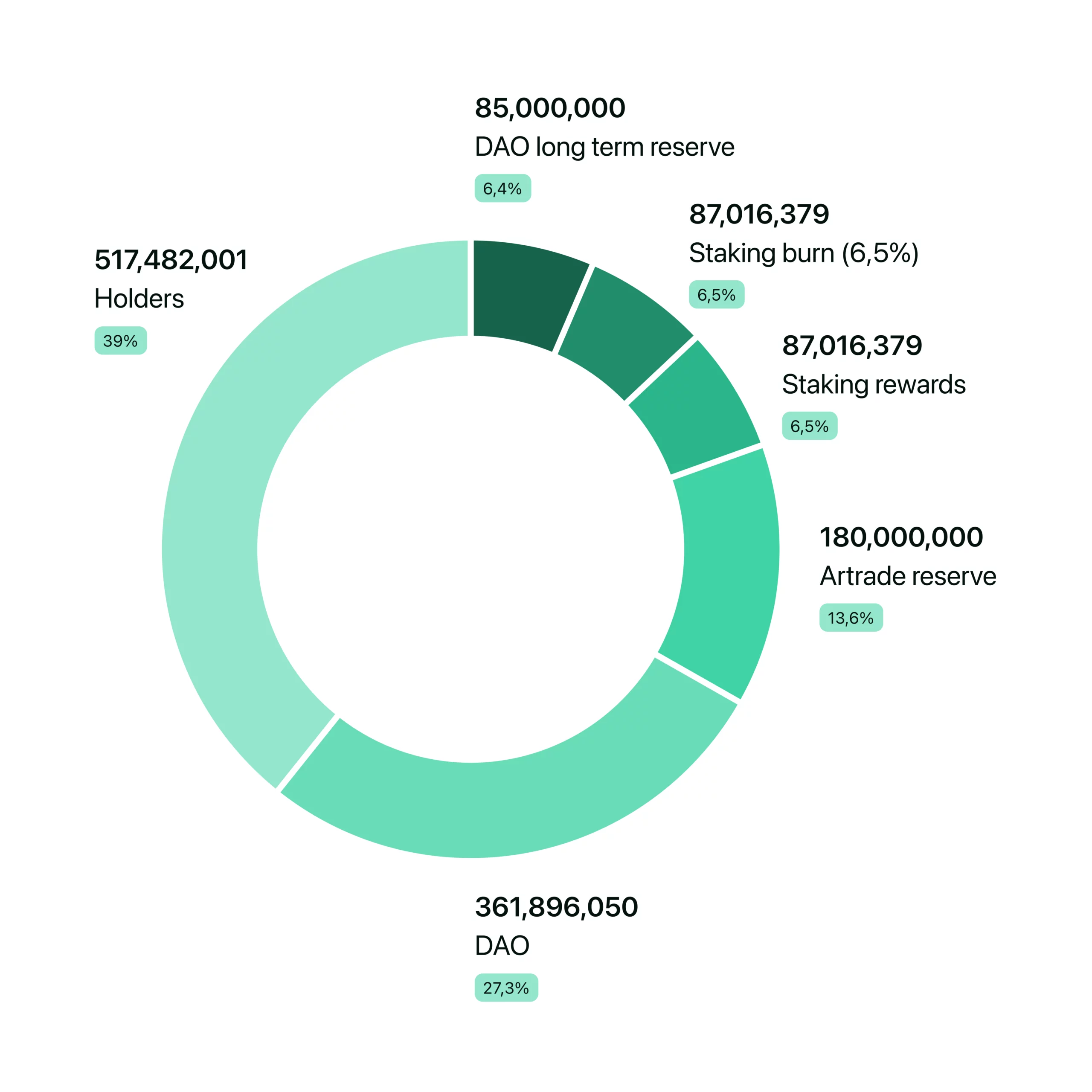
Toutefois, cela ne signifie pas que tous les ATR sont immédiatement disponibles sur le marché. Une partie est encore stockée dans des réserves, notamment :
- La réserve Staking Rewards, qui sert à financer les récompenses des utilisateurs qui verrouillent leurs ATR.
- La réserve Staking Burn, qui est destinée à être progressivement détruite pour maintenir l’équilibre du système.
- Les réserves de la DAO, qui seront libérées progressivement en fonction des décisions prises par la gouvernance.
Ces tokens ne sont donc pas encore en circulation, ce qui signifie que la quantité d’ATR réellement échangeable peut varier selon la vitesse de libération des fonds.
D’où viennent les récompenses de staking et le cashback ?
Artrade utilise deux sources distinctes pour rémunérer les utilisateurs via le staking et le cashback :
Le Buyback : une distribution financée par les revenus de la plateforme
- Mécanisme : Chaque transaction réalisée sur Artrade est soumise à une commission de 5 %, perçue en USDC ou autre stablecoin.
- Utilisation des fonds : Ces revenus sont ensuite utilisés pour acheter des ATR sur le marché (CEX ou DEX comme Raydium).
- Redistribution : Les ATR ainsi rachetés sont distribués aux utilisateurs sous forme de :
- Récompenses de staking pour ceux qui verrouillent leurs tokens.
- Cashback pour les acheteurs et vendeurs (2,5 % chacun).
Dans ce cas, aucun token supplémentaire n’est ajouté à la supply : il s’agit simplement d’un mécanisme de redistribution de tokens existants.
La réserve Staking Rewards : une libération progressive
- Pourquoi existe-t-elle ?
Lors de la création du projet, une quantité d’ATR a été prémintée et mise en réserve pour les récompenses de staking.
- Problème potentiel
Si ces tokens sont débloqués et injectés dans l’économie sans contrepartie, cela risque d’augmenter progressivement l’offre en circulation, même en l’absence de mint. - Solution : un mécanisme de burn compensatoire
Le burn pour stabiliser (voire réduire) l’offre en circulation d’Artrade (ATR)
Pour éviter que la libération de tokens issus des réserves Staking Rewards ne provoque une hausse progressive de l’offre, Artrade a mis en place un programme de burn automatique.
Qu’est-ce qui est brûlé ?
Chaque fois qu’un certain nombre d’ATR est débloqué depuis la réserve pour être distribué en staking, une quantité équivalente est détruite depuis la réserve « Staking Burn ».
- Effet immédiat : Le solde total des tokens en circulation reste inchangé.
- Résultat sur le long terme : Si le volume de burn dépasse la quantité de tokens distribués, l’offre globale diminue, créant une pression déflationniste.
Burn et buyback : deux mécanismes distincts mais complémentaires
| Mécanisme | Rôle | Impact sur l’offre en circulation |
|---|---|---|
| Buyback | Racheter des ATR sur le marché pour les redistribuer (staking et cashback) | Pas d’augmentation, mais soutien du prix en augmentant la demande |
| Burn | Détruire les tokens issus des réserves pour éviter une inflation cachée | Réduction progressive de la supply en circulation |
Un équilibre entre distribution et destruction d’ATR
- Aucune nouvelle émission : La quantité totale d’ATR est figée à 1,8 milliard.
- Les récompenses proviennent du buyback et des réserves existantes.
- Le burn empêche l’inflation cachée due à la libération des réserves Staking Rewards.
- Le système peut devenir déflationniste si les tokens brûlés surpassent la distribution.
En conclusion, même si tous les ATR ont été mintés dès le départ, leur libération progressive et leur destruction compensatoire font en sorte que l’offre en circulation reste maîtrisée. Si le volume de burn continue à surpasser la distribution, l’offre totale d’ATR diminuera, renforçant potentiellement la rareté du token sur le long terme.
Plateforme et expérience utilisateur d’Artrade
Accès simplifié
L’équipe Artrade met en avant plusieurs éléments pour faciliter l’usage de sa plateforme, notamment auprès d’investisseurs ou d’artistes peu familiers du Web3 :
- Web3Auth : Système d’authentification via Google ou autres services SSO (prévu en Q4 2024).
- Artrade Wallet : Un portefeuille dédié, intégré à la plateforme.
- Intégration fiat : Stripe et Moonpay pour des paiements par carte, ce qui peut réduire la barrière à l’entrée.
Réseau social et collaboration
Artrade propose un espace de messagerie privée entre artistes, collectionneurs et galeristes, et encourage la co-création. L’idée d’un réseau social dédié à l’art associé à une dimension blockchain est intéressante. Toutefois, la réussite dépendra d’une communauté active et la capacité à convaincre galeries et acheteurs de s’inscrire sur la plateforme.
Initiatives du projet crypto Artrade pour populariser l’art tokenisé
Éducation et sensibilisation
Le marché de l’art tokenisé (ou la « tokenisation ») n’est pas familier au grand public. Artrade entend déployer des campagnes de communication pour :
- Expliquer le fonctionnement de la blockchain dans l’authentification d’œuvres.
- Mettre en avant les NFT comme certificats numériques.
- Former les galeries et artistes via des didacticiels ou modules d’apprentissage.
Toutefois, l’importance des ressources allouées à ces actions reste encore inconnue. Pour un projet à petite capitalisation, les moyens peuvent être limités, même s’il bénéficie déjà d’un certain soutien communautaire.
Soutenir les artistes émergents
La DAO Artrade pourrait, à terme, acheter des œuvres de nouveaux talents, leur permettant de gagner en visibilité. Selon la documentation officielle, une partie conséquente des tokens (jusqu’à 51 %) sera dédiée à ces actions, mais la roadmap ne précise pas encore le volume d’achats d’œuvres déjà effectué ou prévu.
Indicateurs et chiffres-clés du projet crypto Artrade
Bien que le projet Artrade demeure jeune, plusieurs données chiffrées permettent d’en appréhender l’évolution actuelle :
Prix du token et capitalisation
À la mi-février 2025, le prix s’établit autour de 0,0188 USD par ATR et la capitalisation boursière avoisine les 23,77 millions de dollars, selon les informations affichées sur la plateforme officielle.Quantité brûlée et TVL
Artrade affirme avoir brûlé au total 535,87 millions d’ATR, illustrant la mise en œuvre du programme de burn. Par ailleurs, la plateforme revendique une valeur totale verrouillée (TVL) de 80,92 millions d’ATR soit un peu plus d’1 millions de dollars à l’heure actuelle (février 2025), ce qui indique le volume de jetons actuellement bloqués dans le cadre du staking ou d’autres usages.Holders
D’après CoinMarketCap, plus de 8 700 détenteurs (holders) possèdent des ATR, même si une partie devra encore migrer leurs tokens vers la blockchain Solana dans les mois à venir.Fractionnalisation d’un Picasso
Artrade met en avant la première vente de “Fragments” autour d’un dessin de Pablo Picasso, vendu pour 200 000 USD à 159 investisseurs. Cette opération, réalisée sur la blockchain Solana, représente un signal d’intérêt pour la fonctionnalité de fractionnalisation, bien qu’il soit encore tôt pour mesurer l’ampleur réelle de l’adoption.
Si ces chiffres illustrent une certaine dynamique au sein de la communauté Artrade, le projet reste encore en phase de déploiement. Les collaborations annoncées et l’évolution future du marché détermineront dans quelle mesure Artrade pourra élargir sa base d’utilisateurs et renforcer sa légitimité dans le secteur de l’art tokenisé.
Plus di’nformations sur les récompenses ici
Feuille de route et prochaines étapes
Artrade publie régulièrement sa roadmap. Voici un aperçu des objectifs fixés, avec la conscience que certains délais peuvent évoluer :
-
Q4 2024 :
- Intégration Web3Auth (Google, autres sign-ons).
- Artrade wallet opérationnel.
- Paiements par carte (Moonpay).
- Ébauche d’une campagne marketing crypto à l’international.
-
Q1 2025 :
- Collaboration avec des marques de luxe.
- Amélioration de l’UX/UI et lancement d’un système de revenue-sharing plus automatisé.
-
Q2 2025 :
- Participation renforcée à la Paris Blockchain Week.
- R&D sur la RWA collateralization : possibilité d’utiliser les œuvres fractionnalisées comme collatéraux dans certains protocoles DeFi.
-
Q3 2025 :
- Intégration de Chainlink pour les oracles.
- Recherche et développement sur les Real World Assets (RWA) et la finance décentralisée.
-
Q4 2025 :
- Partenariats avancés avec des maisons de luxe.
- Mise en place d’une tokenization infrastructure pour d’autres marchés.
Cette feuille de route est ambitieuse, mais les retards ou ajustements sont courants pour tout projet crypto. Il est donc sage de considérer ces jalons comme des objectifs plutôt que des garanties.
Conclusion : un projet à suivre, mais encore en phase de développement
Artrade se positionne comme un acteur cherchant à réduire la barrière d’entrée dans l’univers de l’art en s’appuyant sur la blockchain. Son concept de Fragments, son protocole REAL, et l’éventualité d’une gouvernance via la DAO démontrent une volonté d’innovation. Toutefois, son statut de petite capitalisation et son déploiement progressif signifient que la plateforme n’a pas encore acquis une renommée ou une assise financière comparable à d’autres grands noms du secteur Web3.
Pour les passionnés de NFT et d’art, Artrade représente une opportunité de découvrir l’émergence de la tokenisation appliquée aux œuvres. Il est néanmoins prudent de se rappeler que le succès de ce type de projet dépend de multiples facteurs : adoption du grand public, sérieux du développement technologique, respect de la réglementation, et capacité à tenir ses promesses de roadmap.
Les investissements dans les crypto-monnaies sont risqués. Crypternon ne pourrait être tenu responsable, directement ou indirectement, pour tout dommage ou perte causé suite à l’utilisation d’un bien ou service mis en avant dans cet article. Les lecteurs doivent faire leurs propres recherches avant d’entreprendre toute action et n’investir que dans les limites de leurs capacités financières. Les performances passées ne garantissent pas les résultats futurs. Cet article ne constitue pas un conseil en investissement.
Certains liens de cet article sont des liens de parrainage, ce qui signifie que si vous achetez un produit ou vous inscrivez via ces liens, nous percevrons une commission de la part de l’entreprise parrainée. Ces commissions n’entraînent aucun coût supplémentaire pour vous en tant qu’utilisateur et certains parrainages vous permettent d’accéder à des promotions.
Recommandations de l’AMF. Il n’existe pas de rendement élevé garanti, un produit présentant un potentiel de rendement élevé implique un risque élevé. Cette prise de risque doit être en adéquation avec votre projet, votre horizon de placement et votre capacité à perdre une partie de cette épargne. N’investissez pas si vous n’êtes pas prêt à perdre tout ou partie de votre capital.
Pour aller plus loin, lisez nos pages Mentions Légales, Politique de confidentialité et Conditions générales d’utilisation.

Crypternon
Ingénieur de formation, je me suis rapidement intéressé au domaine de la finance. Convaincu que la finance décentralisée a de beaux jours devant elle, je participe à sa démocratisation en développant Crypternon.