

Easy
What is a crypto domain name?
A crypto domain name, or blockchain domain name, is a solution that simplifies interactions in the world of cryptocurrencies and Web3 . It transforms complex cryptographic addresses (e.g., “0x4b20993bC481177eCdcCd9…”) into simple and memorable identifiers, such as “mywallet.eth” or “charity.crypto”.
These domain names play a central role in decentralized finance, simplifying transactions, facilitating decentralized hosting, and offering a new way to manage one's digital identity.
Table of contents
How blockchain domain names work
Decentralized and unchanging management
Unlike traditional domain names (.com, .fr), managed by centralized authorities such as ICANN (Internet Corporation for Assigned Names and Numbers), crypto domain names rely on decentralized blockchains. These blockchains guarantee security, immutability, and full ownership.
What does it mean to register a domain name on the blockchain?
Registering a crypto domain name involves inscribing it on a blockchain via a smart contract . This registration includes:
- The owner : the wallet address holding the domain (often represented as an NFT).
- Metadata : redirection information, such as an IPFS (InterPlanetary File System) identifier pointing to decentralized content or site.
- Action history : every modification or transfer is recorded, time-stamped and publicly accessible.
Blockchains, initially designed to record financial transactions, are evolving to store complex data through smart contractcontracts. This data is immutable and accessible at any time, unlike centralized DNS ledgers.
Differences between crypto domain names and traditional domain names
Centralized management: the case of traditional domains
Traditional domain names, such as .com or .fr, are administered via the Domain Name System (DNS).
- Temporary ownership: The user rents the domain for a limited period (1 to 10 years).
- Mandatory renewal: If the subscription is not renewed, the domain may be reclaimed or purchased by a third party.
- Risk of censorship: Authorities may suspend a domain for various reasons.
Decentralized management: blockchain domain names
With crypto domain names:
- Actual ownership: The user owns the domain in the form of an NFT.
- Total transparency: The information is accessible on the blockchain.
- Immunity to censorship: No third party can suspend or revoke a blockchain domain.
The main crypto domain name platforms
1. Ethereum Name Service (ENS)
- Extension: .eth
- Blockchain: Ethereum
- Ethereum addresses and seamlessly integrating with decentralized applications ( dApp ) like Uniswap and OpenSea. ENS domains are particularly popular in the Ethereum due to the robustness of this blockchain and its widespread adoption.
- Special feature: .eth domains require annual renewal fees, calculated based on the length of the name. For example, a domain of 5 characters or more costs approximately $5 per year (excluding gas fees).
2. Unstoppable Domains
- Extensions: .crypto, .wallet, .x, .nft, .blockchain, etc.
- Blockchain: Polygon (a Layer 2 solution on Ethereum)
- Main use: Multi-blockchain compatibility, allowing simplified payments on different blockchains while offering the possibility of hosting content via IPFS.
- A key feature: These domains are sold with a one-time payment and no renewal fees, making them an ideal solution for those seeking simple, lifetime management. They also allow users to receive funds on multiple blockchains such as Ethereum , Solana , or Bitcoin.
3. Solana Name Service (SNS)
- Extension: .sol
- Blockchain: Solana
- Primary use: Simplifying transactions and interactions within Solana's fast-paced and evolving ecosystem. Highly valued by active users on this blockchain, these domains can be used to identify wallets or projects deployed on Solana.
- Special feature: A single purchase guarantees ownership of the domain for life, with no renewal fees.
4. BTC.us
- Extension:btc
- Blockchain: Stacks (a Layer 2 of Bitcoin)
- btc domains facilitate Bitcoin payments while connecting to the Lightning Network for fast and inexpensive transactions. They are particularly well-suited for merchants and users who accept Bitcoin as a payment method.
- Special feature:btc domains are available for a fixed period of 5 years against a payment of 2 STX (native token of Stacks), after which renewal is required.
Other major platforms for buying a crypto domain name
Apart from the four platforms mentioned, many other solutions exist, each adapted to specific blockchains or needs:
- Space ID : Offers extensions like bnb , .arb, and others for the Binance Smart Chain and Arbitrum . Primarily aimed at simplifying interactions on these networks.
- Bonfida : An alternative to SNS for Solana , offering similar features, but often at lower costs.
- Polygon Name Service (PNS) : Dedicated to users of the Polygon , these domains are designed to integrate with the dApp of this rapidly expanding network.
- Base Name Service (BNS) : Specific to the Base blockchain (incubated by Coinbase ), with extensions like .base, which target users of this Layer 2 network.
- Starknet Name Service (SNS) : Enables the purchase of .stark domains for those who interact with the StarkNet , specializing in highly scalable decentralized applications.
- Tron Name Service (TNS) : Offers .trx domains for users active in the Tron ecosystem.
How to buy a crypto domain name step by step
Buying a crypto domain name, such as .eth, .crypto, .sol, or .x, is relatively simple thanks to specialized platforms. Here are the steps to follow:
- Choose a suitable platform:
- Identify the platform corresponding to the extension you want, for example:
-
- Ethereum Name Service (ENS) for .eth names.
- Unstoppable Domains for .crypto, .wallet, .x.
- Solana Name Service (SNS) for .sol.
-
- Preparing a crypto portfolio:
Download a wallet that supports the blockchain associated with your desired domain name. For example, Exodus is an excellent option because it supports many blockchains, eliminating the need for multiple wallets. Alternatively, you can use MetaMask for Ethereum and compatible EVM chains, and Phantom for Solana , for example. Deposit the cryptocurrency needed for the purchase into the wallet. For example:
-
-
- ETH for ENS.
- SOL for SNS.
- USDC or MATIC for Unstoppable Domains.
-
To learn how to use a decentralized wallet, we have created a step-by-step guide, with supporting screenshots.
What you will learn:
✔ Mastering a decentralized wallet ( DeFi ) – Learn how to manage your assets without intermediaries and interact directly with the blockchain.
✔ Transacting via a decentralized wallet – A practical guide to trading cryptocurrencies independently.
✔ Exploring decentralized finance ( DeFi ) – Discover advanced concepts like staking and NFTs .
📥 Download your free guide by filling out the form below:
- Search for an available name:
- Connect your wallet to the platform.
- Enter the name you wish to purchase in the search bar.
- Check its availability. If the name is already taken, the platform will often suggest alternatives or ways to contact the owner to negotiate a purchase.
- Configure the purchase:
- Choose the registration duration for platforms with renewal (like ENS). For example, a .eth name can be registered for a period of 1 to 10 years.
- On Unstoppable Domains or SNS, the payment is a one-time payment, with no renewal.
- Pay and confirm:
- Confirm the transaction via your crypto wallet. You will also have to pay network fees (called gas fees ) on some blockchains like Ethereum .
- Wait for the transaction to be validated on the blockchain. This can take from a few seconds to several minutes, depending on network congestion.
- Manage your domain:
- Once purchased, your domain name is visible in your crypto wallet as an NFT.
- Configure it to associate your wallet address, a decentralized website (via IPFS), or information related to your Web3 identity.
Practical example:
If you wish to purchase monentreprise.eth:
- Prepare 0.03 ETH (approximately $5 for 1 year of registration + gas fees).
- Connect your Exodus wallet to ENS
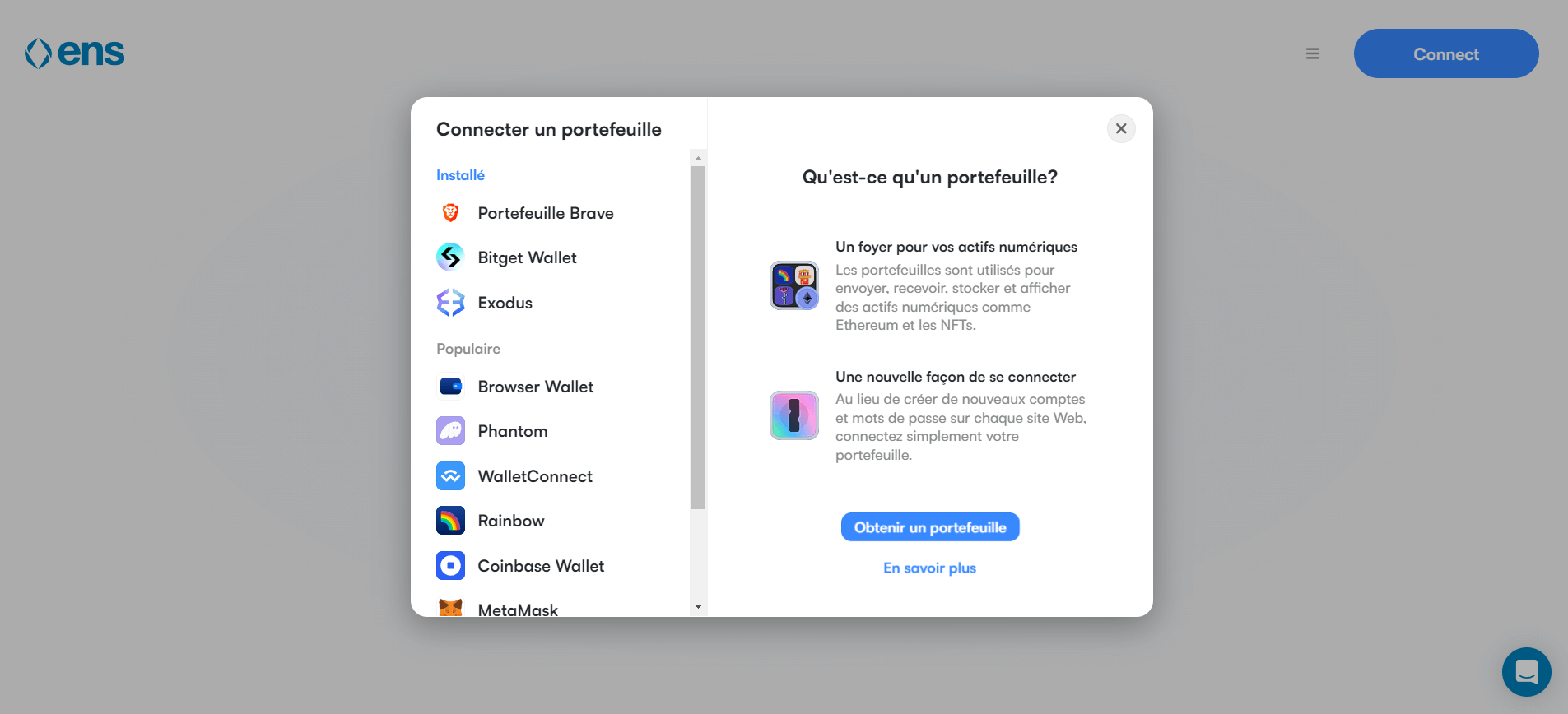
- Search for "mycompany.eth".
- Configure the recording period.
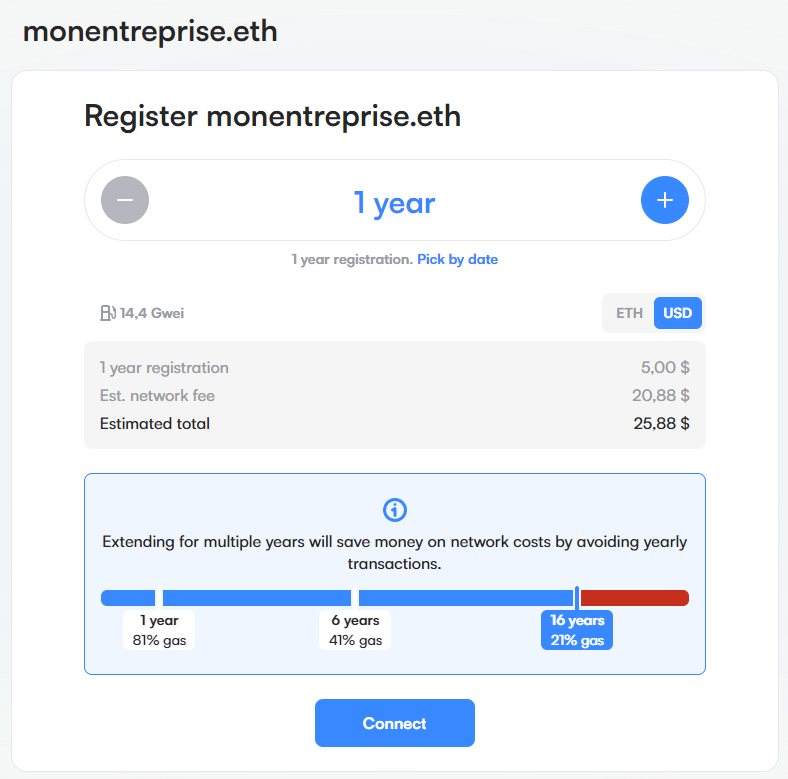
3. Confirm the transaction in Exodus.
4. The domain is now yours and linked to your Ethereumaddress.
- Resistance to censorship
Blockchain domain names, combined with IPFS, guarantee decentralized and censorship-proof hosting.
- Outright ownership and total control
Some domains, like those of Unstoppable Domains, are acquired for life, offering total freedom and resistance to outside interference.
The challenges and limitations of crypto domain names
While blockchain domain names offer many advantages, they are not without challenges and limitations. It is important to be aware of these before committing to this technology.
- Limited compatibility with the traditional web
Blockchain domain names are not directly accessible through traditional web browsers like Google Chrome or Safari. Unless specific extensions or compatible browsers like Brave are used, these domains will not function like traditional domains.
- Lack of centralized regulation
The absence of a central entity, while a strength for decentralization, can be a hindrance in the event of disputes or cybersquatting. Unlike established procedures for traditional domain names, such as the UDRP for disputes, there is no universal mechanism for managing conflicts related to blockchain domain names.
- Adoption still limited
Despite their rapid growth, these domains are still primarily adopted by Web3 and crypto players. For mainstream use, particularly in businesses outside the crypto ecosystem, blockchain domain names have yet to prove their value.
- Transaction costs
For some platforms, such as ENS, Ethereum gas fees can be prohibitive, especially during periods of high network activity. This can make acquiring or renewing a domain expensive.
Future prospects for crypto domain names
Blockchain domain names are part of a broader vision of Web 3: a decentralized, secure, and autonomous internet. Here are the key trends for their development:
- Increased interoperability
As blockchains develop bridges between them, domain names could evolve to become even more interoperable. For example, a .crypto domain could be used for interactions on blockchains like Aptos, Base, or Avalanche.
- Better integration with the traditional web
Initiatives are underway to make blockchain domain names compatible with DNS, thus enabling wider adoption. These efforts could reduce reliance on specific browsers and extensions.
- Expanded use cases
Beyond crypto payments, blockchain domain names could become universal identifiers for accessing digital services, managing online identities, or participating in decentralized governance systems.
- Institutional adoption
Companies and institutions are beginning to explore the use of blockchain domain names for specific use cases, such as cryptocurrency donations or the creation of decentralized hubs for their communities.
Practical tips for choosing and managing a crypto domain name
- Assess your needs: Determine if you need a domain compatible with a specific blockchain or multi-network.
- Favor recognized platforms: Choose platforms like ENS or Unstoppable Domains to guarantee the security and reliability of your domain.
- Anticipate costs: If you choose a .eth domain, factor in renewal and gas fees. For a .crypto domain, make sure the initial cost meets your expectations.
- Use compatible tools: Make sure your browsers and wallets are configured to use these domains.
Conclusion on crypto domain names
In conclusion, crypto domain names are not just a technological innovation, but also an opportunity to reinvent the management of digital identities and online interactions. By exploring this field, you are helping to build the future of Web3.
Cryptocurrency investments are risky. Crypternon cannot be held liable, directly or indirectly, for any damage or loss resulting from the use of any product or service mentioned in this article. Cryptocurrency investments are inherently risky; readers should conduct their own research before taking any action and only invest within their financial means. Past performance is not indicative of future results. This article does not constitute investment advice .
Some links in this article are affiliate links, which means that if you purchase a product or sign up through these links, we will receive a commission from our partner. These commissions do not incur any additional cost to you as a user, and some partnerships allow you to access promotions.
AMF recommendations. There is no guaranteed high yield, a product with high performance potential implies a high risk. This risk taking must be in line with your project, your investment horizon and your ability to lose part of this savings. Do not invest if you are not ready to lose all or part of your capital .
To go further, read our pages legal notices , privacy policy and general conditions of use .

Yoann
Training engineer, I quickly became interested in the field of finance. Convinced that decentralized finance has a bright future ahead of it, I participate in its democratization by developing Crypternon.